The Venice dispatch
Sofia Hallström reports on a politicised Venice Biennale
The 61st iteration of the Venice Biennale is one of the most politically charged and heavily policed biennales in recent history. Funded by government bodies and structured around the geopolitical theatre of nation states in the Giardini and Arsenale, the opening week has unfolded amid strikes, protests, resignations and mounting political unrest. Today, hundreds of activists line the canals towards the Arsenale. Led by the Art Not Genocide Alliance (ANGA), a large, peaceful demonstration is held outside the Israeli pavilion, which this year occupies a temporary location in the Arsenale while its permanent site in the Giardini undergoes renovation. Palestinian flags and banners read “No Artwashing Genocide”. Alongside this, many of the pavilions are closed today in a daylong strike, with cultural workers closing pavilions in solidarity with Palestinians. The tensions surrounding this year’s opening feel especially poignant in light of the late curator Koyo Kouoh’s vision. Conceived as a meditation on tenderness, listening and fragile forms of connection in a fractured world, the curated exhibition In Minor Keys opens with a passage from the poem “If I Must Die” by the late Palestinian poet Refaat Alareer. Throughout the opening week Pussy Riot has staged action outside the Russian Pavilion with smoke flares, chanting and flyers reading “Death in Venice. No to the Genocide Pavilion” as Russia’s pavilion opened for the first time since 2022.
The Palestine US Museum shows visceral documentation of the ongoing genocide, whilst Gabrielle Goliath’s Elegy at the Chiesa di Sant’Antonin brings together a multi-channel video and performance series honouring victims of femicide, queer killings, and the German genocide in colonial Namibia. The presentation was originally blocked by South Africa’s culture minister for its inclusion of the genocide in Gaza. The Patriarchate of Venice offered the 12th-century church to house the exhibition.
At the Complesso dell’Ospedaletto, Fondazione In Between Art Film’s Canicula presents eight new site-specific installations, including Janis Rafa’s meditation on the meat industry and Lawrence Abu Hamdan’s forensic account of a sonic weapon used against a silent Belgrade vigil in 2025. At Ocean Space in the former Church of San Lorenzo, the Repatriates Collective’s Tide of Returns floods the west wing with reddish sand from Anindilyakwa Country, scattered with thousands of shell-and-grass Indigenous Australian dolls recently returned from European museums. Moscow-born, New York-based artist Sanya Kantarovsky is showing paintings and sculptures of resin-cast heads encasing large black spiders at the grand Palazzo Loredan.
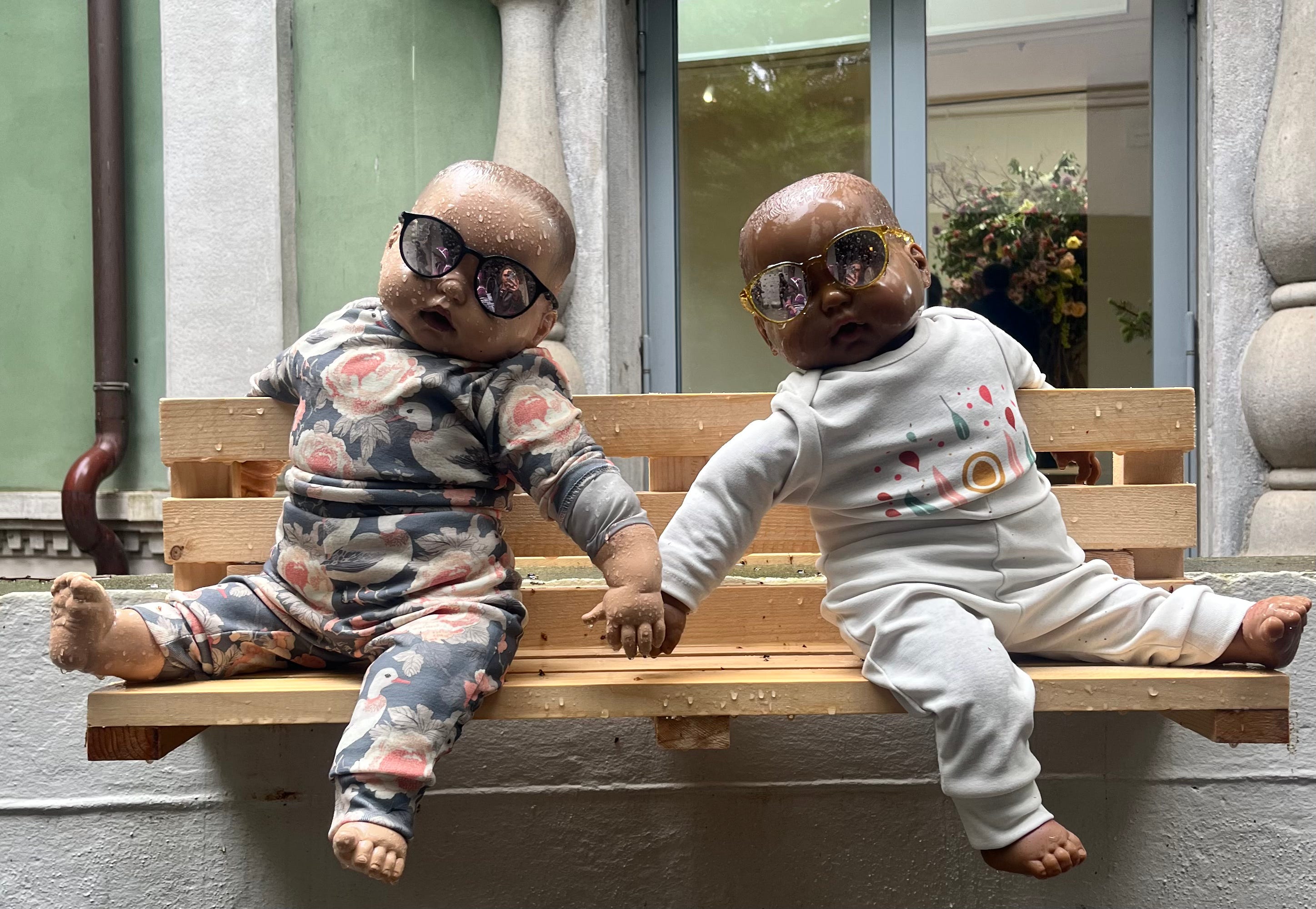
At the Arsenale, the Latvian Pavilion presents Untamed Fashion Assemblies, documenting a carnivalesque annual festival in Riga (1990–99) that brought together alternative fashion, drag, and visual art during the Soviet collapse. At the Giardini, Ruin is presented in the German Pavilion by Sung Tieu and the late Henrike Naumann, curated by Kathleen Reinhardt. Vast trompe-l’oeil mosaics wrap the façade, recreating graffiti and the ruins of a prefabricated East Berlin block on Gehrenseestrasse, which was once a dormitory for Vietnamese contract workers in the GDR. Japan’s Ei Arakawa-Nash fills Grass Babies, Moon Babies with 208 weighted baby dolls, each matching the heft of a real infant. The pavilion is filled with visitors caring for and changing the nappies of the babies. Prams line the exterior of the packed pavilion.
The art world’s embrace of the political has never been so clear as at this year’s competition. The real question is whether it will continue to do so when the cameras leave and the champagne runs dry, when Kouoh’s call for tenderness must compete with the machinery of institutional power. It is a vision that takes on new weight in Venice – a city whose very foundations are sinking into the sea.
Sofia Hallström
MORE IN YOUR TANK
WATCH HERE
Writer Fatima Bhutto and TANK editor-in-chief Masoud Golsorkhi, in conversation on Iran. Discussing whether the revolution has been given a second wind and the effect of Khamenei’s assassination.
LISTEN HERE
Moving through house, progressive, Miami bass, ghettotech and UK garage, this week's TANK Mix from Azo has a warm, sensual current running through it. In Azo’s own words, the sound is inspired by “golden hour, that moment when the light turns orange and everything slows down.”